
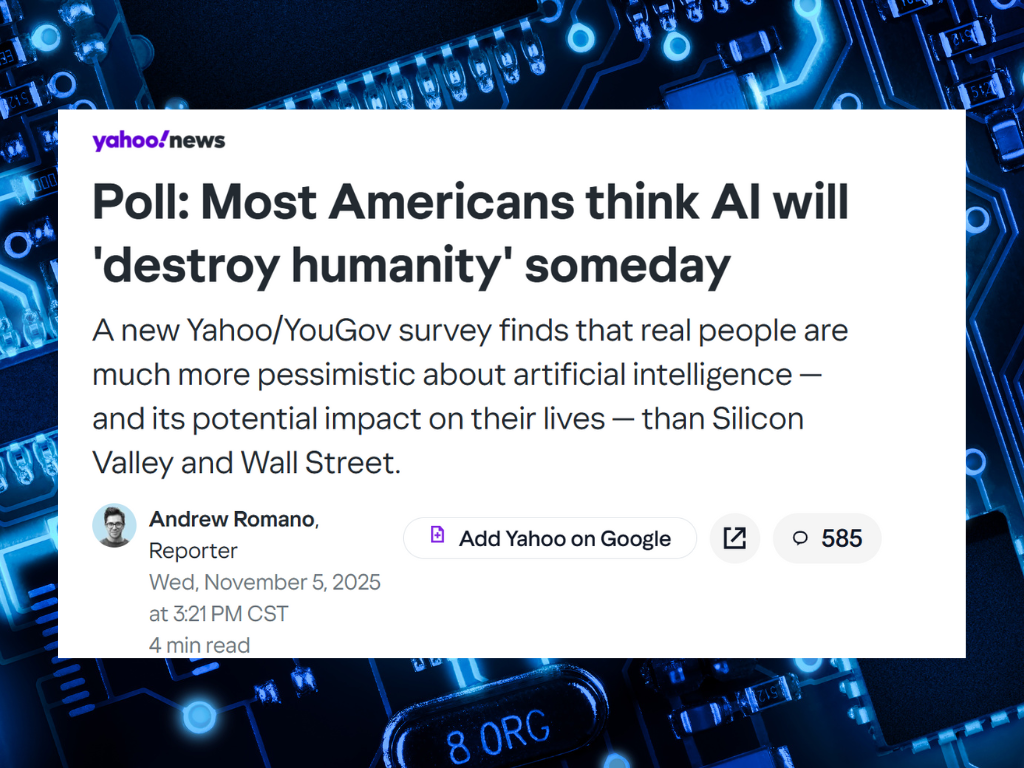
Well, That’s Depressing
53 percent of Americans believe AI Will Destroy Humanity
As reported by Yahoo News, a recent national survey conducted by Yahoo News and YouGov shows significant public fear regarding the long-term future of artificial intelligence.
The poll found that 53 percent of Americans believe that AI will eventually lead to the destruction of humanity. This concern is matched by the belief among a majority of respondents that AI systems will become so intellectually advanced that human beings will no longer be able to control them. However, this deep pessimism is balanced by high expectations for the technology, with many Americans simultaneously anticipating that AI will solve complex global issues, such as curing cancer. This survey highlights a critical disconnect between the concerns of the general public and the optimistic outlook frequently shared by technology innovators.
We Get It
Big Tech and the big money boys driving AI investment often forget about the human factor. In the rush to replace everything with AI or robots, people rightly feel forgotten. We hear you. We get it.
Innovative AI Solutions believes in ethical AI – We don’t believe in displacing people with AI. AI is supposed to enhance your work, not take your job.
There is Good News
The good news is today’s AI isn’t really intelligent. It’s not capable of independent thought. AI systems that are equal to human intelligence are years away. AI that is equal to human intelligence is called Artificial General Intelligence (“AGI”). Most experts believe AGI is years away. Some believe AGI research is on the wrong track and will never succeed with current models.
AI for Business Today
AI solutions for business fall into two general categories: Large Language Models and AI Agents.
Large Language Models/Chatbots
You may be familiar with Large Language Models (“LLMs”) through chatbots such as ChatGPT, Google Gemini or Microsoft Copilot. These systems are trained on massive amounts of text, code and images. LLMs excel at language-based tasks. These Chatbots are generative. They create text, images or video in response to text prompts entered by the user. A skilled user can use Chatbots to analyze problems and suggest solutions.
Three Use Cases for Large Language Models
Information Synthesis and Research
Once you learn how to prompt chatbots, chatbots can help your research by
- Summarizing complex articles, simplifying concepts, answering detailed questions and conducting research
- Searching internal knowledge base articles and helping customer service agents find the best solutions to problems
- Providing improved internet search results. Chatbot search is rapidly replacing search engines such as Google, Bing or Yahoo
Fast Content Drafting
You can use a chatbot to
- Quickly drafting letters or emails
- Creating images, videos or music
- Creating presentations from your notes
Learning new Skills
AI can work as a personalized tutor. Using chatbots, you can
- Learn difficult topics
- Practice new languages
- Learn technical skills such as coding or financial modeling
AI Agents
An AI Agent is an autonomous system that uses a Large Language Model to process routine tasks.
In business, an agent is a person who works on your behalf, at your direction. An AI Agent is similar in that it works for you to perform tasks you assign it. Think of an AI Agent as an executive assistant. AI Agents are also known as Agentic AI Systems or are sometimes called bots (from the slang term for robot).
Three Use Cases for AI Agents
Sales and Lead Qualification Automation
The agent handles the initial client engagement, so no potential client or customer is ignored and only pre-qualified prospects are passed on the the human sales team. These systems can be available 24/7/365 and can also schedule follow-up calls using an online calendar.
The Payoff for Businesses: By using an AI agent for initial contact, sales agents can focus on pre-qualified leads, improving their efficiency.
Customer Service Resolution
The agent handles frequently asked questions and works to automatically resolve customer issues. The agent handles routine issues and escalates trickier problems to human agents.
The Payoff for Businesses: Since AI agents handle the FAQs and routine issues, customer service agents can focus on unique problems that require more attention and creative problem-solving.
Financial and Administrative Process Automation
Agentic AI systems manage highly repetitive, rule-based administrative and financial tasks, reducing errors and ensuring compliance.
For example, an AI Agent can process accounts receivable. It monitors outstanding invoices, can draft and send personalized reminder emails, and flag past due accounts to the human accounting staff for intervention. The agent can also manage expense categorization and reconcile invoices.
The Payoff for Businesses: In this example, the tedious, routine work is handled by the agent and the human staff is freed for more valuable work.
Hey, Wait a minute…
Don’t these agents replace people?
At Innovative AI Solutions, we believe these agents make people more productive. The goal is to offload the most tedious, time-consuming tasks to agents and free people to focus on more productive work. When AI is used to augment work, employees become more valuable because they get more done in less time. Increased job satisfaction is a welcome side-effect as well.
Other Use Cases for AI Agents
Below are some more common ways small businesses and independent professionals can put AI agents to work for them:
Automated Appointment and Booking Management: The agent communicates with clients to find optimal meeting times, checks your live calendar, sends confirmations, and automatically books the service or consultation.
Lead Nurturing and Qualification: The bot proactively follows up with new prospects via email or chat, scores their level of buying intent, and moves only highly qualified leads to the human sales pipeline.
Invoice and Accounts Receivable Workflow: The agent autonomously monitors outstanding invoices, drafts and sends personalized late payment reminders at pre-set intervals, and updates the accounting ledger upon payment.
Market Data Aggregation and Summarization: The agent searches multiple live sources (e.g., MLS, local news, financial feeds), synthesizes key trends, and generates a concise, market-specific report for client distribution.
Multi-Channel Content Distribution: The agent takes one piece of primary content (e.g., a blog post), re-edits the copy to fit different formats, and schedules it for posting across various social media platforms.
Real-Time Inventory and Supply Monitoring: The bot monitors stock levels or service material inventory and automatically generates and submits a purchase order to the relevant vendor when stock falls below a specific threshold.
Client Document Collection and Verification: The agent guides new clients through the required paperwork submission process, checks documents for completeness and compliance gaps, and flags any missing items before human review begins.
Questions? We can help!
Summary
- Today’s AI is not a threat to humanity
- The proper use of AI is to enhance human productivity, not replace humans
- AI can assist in researching, summarizing information and mastering new concepts and skills
- AI agents can be used for the most repetitive, tedious tasks and allow humans to focus on higher-value work