
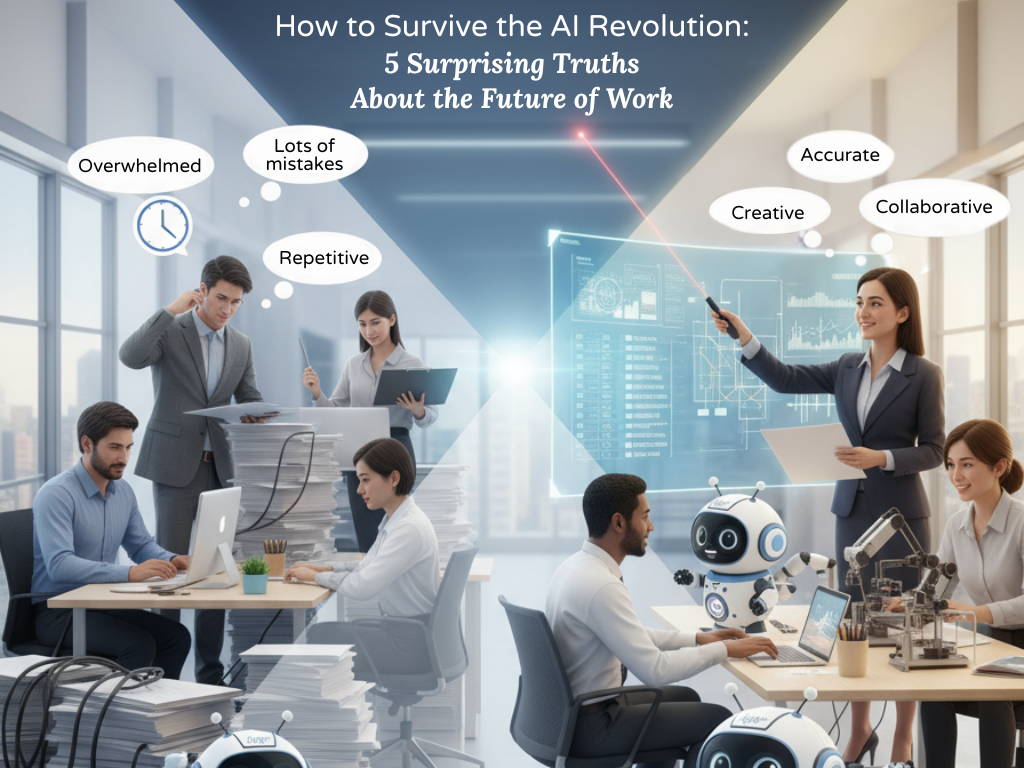
The news is filled with anxiety-inducing headlines about artificial intelligence. We see reports of major layoffs, like Amazon cutting 14,000 corporate jobs, and it’s easy to connect the dots to a narrative of mass replacement. The fear that AI is coming for our jobs is palpable, painting a picture of a future where human workers are obsolete.
But this fear-based narrative misses the bigger picture. The reality of AI’s impact on the workforce is far more nuanced than simple replacement. Instead of a direct competitor, AI is emerging as a powerful collaborator—a tool that augments human capabilities rather than rendering them useless. Your career trajectory is no longer about avoiding replacement; it’s about mastering a new partnership.
This post will cut through the noise to reveal five of the most surprising and impactful findings from recent research, including the World Economic Forum’s “Future of Jobs Report.” These insights provide a practical roadmap to help you navigate this new landscape, turning anxiety into agency.
1. Surprise: AI Is a Net Job Creator, Not a Job Destroyer
While headlines focus on displacement, the data tells a different story. According to the World Economic Forum’s “Future of Jobs Report 2025,” advances in artificial intelligence are projected to create 19 million jobs while displacing only 9 million over the next five years.
This represents a net positive shift of 10 million new roles. This single statistic reframes the entire conversation from one of job loss to one of profound job transformation. This is a crucial counter-narrative because it encourages us to focus our energy on preparing for and transitioning to these new roles, rather than simply fearing obsolescence.
This net gain in jobs isn’t about replacing roles one-for-one; it’s about fundamentally changing the nature of work. This leads to the next key truth: the future is a partnership.
2. It’s Not Human vs. Machine, It’s Human + Machine
The future of work isn’t a zero-sum game between humans and AI; it’s about augmentation, not just automation. The Future of Jobs Report estimates that by 2030, work tasks will be nearly evenly divided between humans, machines, and hybrid approaches where both collaborate.
This means you can strategically offload the repetitive, data-heavy tasks that often lead to burnout, freeing yourself up to concentrate on what humans do best: creative thinking, complex strategy, and nuanced interpersonal responsibilities. This collaborative model unlocks new potential for productivity and innovation.
As Eric Horvitz, Chief Scientific Officer at Microsoft, puts it:
“We’ve barely scratched the surface on human AI collaborative possibilities. It’s such a great area for research right now. We can think deeply about new forms of collaborative work that support the primacy of human agency and contribution.”
As AI takes over repetitive tasks and collaboration becomes the norm, the skills required to succeed are naturally evolving. But surprisingly, the chaos of this ‘Great Reskilling’ may be starting to stabilize.
3. The Pace of Skill Disruption Is… Slowing Down?
In a surprising turn, the World Economic Forum reports that the rapid pace of skill disruption appears to be stabilizing. Employers now expect 39% of a worker’s core skills to change by 2030. While significant, this is a notable decrease from the 44% they predicted just a year earlier in 2023.
This stabilization suggests that the initial shock of technological acceleration, amplified by the pandemic, is giving way to a more sustainable rhythm of adaptation. It may reflect that companies and employees are becoming more adept at integrating continuous learning, upskilling, and reskilling into their regular operations, making them more resilient to ongoing change.
This stabilizing pace of change underscores a powerful new reality: employers are shifting their focus from outdated credentials to the tangible, adaptable skills needed right now.
4. Your Experience Now Matters More Than Your Diploma
One of the most significant shifts in the modern workforce is the rise of skill-based hiring. The Future of Jobs Report highlights that a staggering 81% of employers plan to prioritize work experience as a key evaluation method between 2025 and 2030.
This trend is directly connected to a broader strategy of eliminating academic degree requirements to widen talent pools. For employees and job seekers, the message is clear: what you can do is becoming more important than where you studied. A focus on demonstrating practical skills, highlighting on-the-job learning, and showcasing measurable achievements is now more critical to career success than ever before.
5. The Future of Work Is a “Design Exercise,” Not a Prediction
Perhaps the most empowering realization is that the future of work is not a predetermined outcome that we must passively accept. We are not simply waiting to see what AI will do to us.
This idea was powerfully framed by MIT economist David Autor, citing his friend, the philosopher Joshua Cohen, who said:
“…the future is not a prediction exercise. It is a design exercise.”
This perspective shifts agency directly back to us—as individuals, leaders, and organizations. It is a call to action. We have the collective responsibility to be thoughtful and intentional about how we integrate AI, shaping a future that leverages technology to promote shared prosperity and enhance human potential.
Conclusion: Your Next Move in the Age of AI
The age of AI is pushing us to redefine our relationship with work. The conversation is shifting away from the old ideal of job security and toward a new imperative: career agility. The key to thriving is not to compete against AI, but to become an effective AI collaborator.
The data reveals a future that is less about replacement and more about partnership. We are seeing a net creation of jobs, a move toward human-machine augmentation, a stabilizing of skill disruption, and a rising premium on practical experience over credentials. Most importantly, we have the power to shape this future.
Your Design Blueprint: 3 Immediate Actions
1. Become an AI Collaborator, Not a Casualty. Identify the repetitive, rule-based parts of your job—the tasks that bore you senseless. Learn to delegate them to AI tools. Think of it as upgrading your personal operating system. By strategically offloading routine work, you free up your time for high-value strategic thinking and creative problem-solving.
2. Upskill with Surgical Precision. Don’t just take random online courses. Identify one adjacent “AI-enhanced” skill that complements your current expertise and commit to learning it. If you’re in marketing, learn prompt engineering and AI analytics. If you’re in an administrative role, master automation tools. This focused approach makes you immediately more valuable.
3. Reframe Your Value Proposition. Update your résumé and your interview talking points. Stop highlighting your ability to perform routine tasks and start showcasing how you solve ambiguous problems, manage complex human-AI workflows, and demonstrate adaptability. Your value is no longer in just doing the work—it’s in directing the tools that do the work.
The future is a design exercise. Which specific skill will you start building this week to become the architect of your career, not a bystander to disruption?